
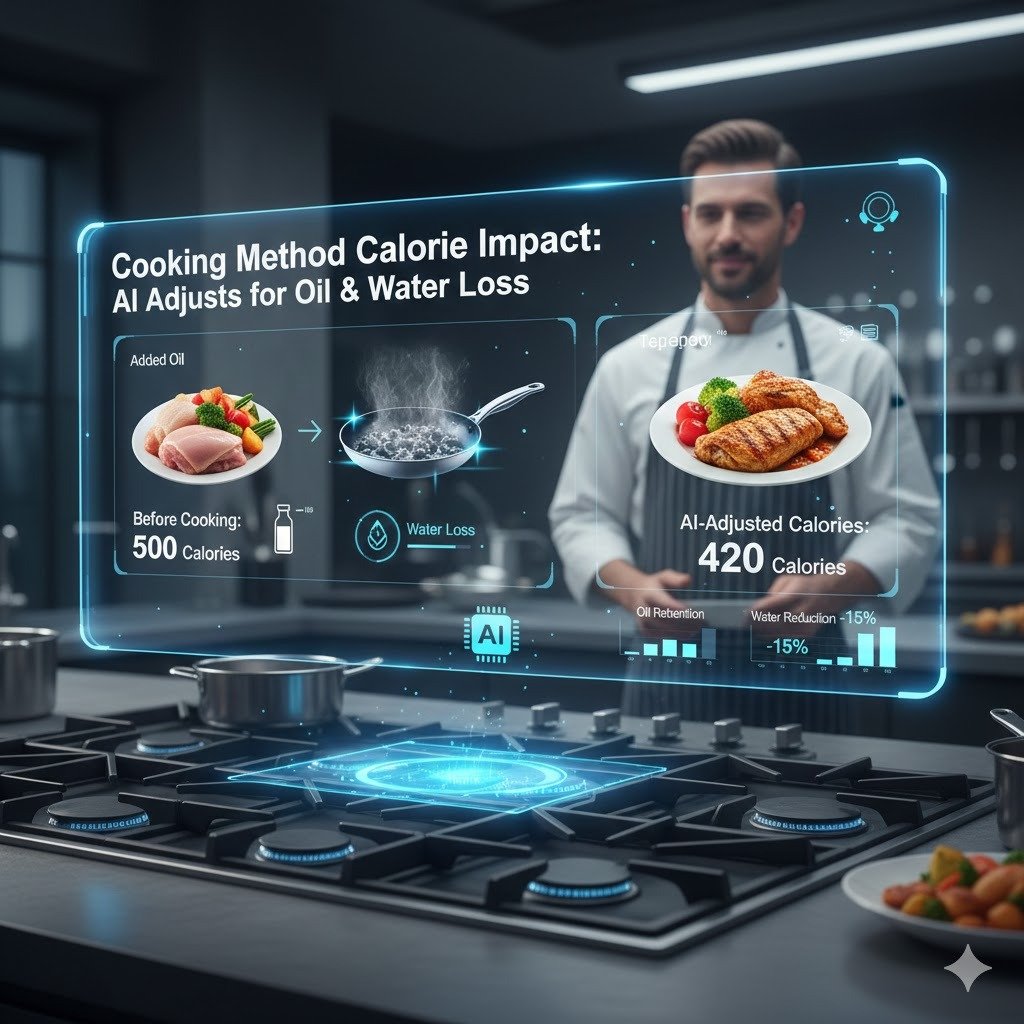
For the Data-Driven Health Enthusiast, the pursuit of Accurate Calorie Tracking often leads to a complex, hidden discrepancy: the difference between raw food data and cooked food reality. You meticulously weigh your ingredients, log the raw values, and follow your macro plan, yet your results subtly drift off target.
The critical variable most traditional tracking apps completely ignore is the transformation food undergoes during preparation. Does cooking change calories? Absolutely. The heat, the medium, and the duration profoundly alter a food’s caloric density, volume, and nutrient profile.
Limotein is built on the principle that the data must reflect reality. Through proprietary AI Cooked Food Analysis and scientific modeling, our platform performs precise Calorie Adjustment for Cooking, ensuring that your logged meal accurately represents what you consumed, not just what the raw ingredients contained. This is the difference between guessing and truly data-driven nutrition.
The Scientific Imperative: Why Raw Data is Always Wrong for Cooked Food
Traditional tracking apps rely on databases that often provide the caloric and macro content for food in its raw state. This is fine for an apple, but catastrophically misleading for a chicken breast or a potato. The act of cooking impacts food in two primary ways that dramatically affect your total intake: physical state change and composition change.
1. The Volume and Density Dilemma (Water Loss/Gain)
Cooking drastically changes the mass and volume of a food item, even if no extra ingredients are added.
-
Dehydration and Concentration: Cooking methods like grilling, baking, or roasting cause significant water loss. A 100g raw chicken breast might shrink to 75g after cooking. If you log the 100g raw data, but eat the 75g cooked portion, your tracking is accurate. However, if you log “100g Cooked Chicken” based on a raw database entry, you are over-reporting calories because the weight you consumed is now calorically denser.
-
Hydration and Dilution: Conversely, foods like rice, pasta, or oatmeal absorb water. 100g of dry rice becomes 300g+ of cooked rice. If you log 100g of cooked rice using a raw entry, you are drastically under-reporting calories.
This volatility is why 3D Food Volume Estimation alone is insufficient; it must be paired with accurate density factors derived from AI Cooked Food Analysis.
2. The Compositional Shift (Oil Absorption/Leaching)
The cooking medium—especially fats and oils—creates the largest caloric variability.
-
Oil Absorption Calorie Difference: Frying is the most extreme example. Foods like chicken, potatoes, or dough absorb cooking oil during the process. While you might use 20g of oil in the pan, the food may absorb 5g, 10g, or more, depending on the food’s surface area, porosity, and cooking time. Those absorbed calories, often pure fat, are never logged by traditional methods.
-
Nutritional Change in Cooking: Nutrients also leach out. Boiling vegetables can cause water-soluble vitamins (like Vitamin C and B vitamins) to leach into the cooking water, which is then often discarded. This decreases the AI Nutrient Density of the final product.
Key Takeaway for the User: Accurate calorie tracking requires tracking the Cooking Method Calorie Impact. Ignoring the transformation from raw to cooked introduces systemic errors that undermine long-term progress.
Limotein: The Only AI Solution for Calorie Adjustment for Cooking
Limotein leverages scientific data models and its superior AI Cooked Food Analysis to bridge the gap between lab-based food composition and real-world consumption. We don’t just recognize the food; we understand its state.
 Also Read:
Gut Microbiome Protocols: Tracking Prebiotics and Probiot...
Also Read:
Gut Microbiome Protocols: Tracking Prebiotics and Probiot...
Feature 1: Dynamic State Recognition (The AI Cooked Food Analysis)
When you use the Limotein AI-Powered Food Logging feature, the computer vision engine doesn’t just see “chicken”; it sees “Grilled, well-seared chicken breast.”
-
Method Identification: The AI is trained to recognize visual cues of preparation (e.g., sear marks, moistness, oil sheen, crispness) to classify the cooking method (Grilled, Boiled, Fried, Baked, Steamed).
-
Density Factor Adjustment: Based on the identified method, the AI applies a known, scientifically validated density adjustment. For grilled chicken, a higher density factor is applied to account for water loss. For boiled rice, a lower density factor is applied to account for water gain. This corrects the volumetric calculation for the change in mass.
-
Oil Absorption Modeling: If the method is identified as high-fat cooking (e.g., pan-fried), the AI automatically applies a scientifically conservative estimate for Oil Absorption Calorie Difference, adding those hidden calories to your log.
Feature 2: Nutritional Change in Cooking Protocol Integration
Limotein’s advanced guidance systems account for the impact of heat on micronutrients, which directly feeds into the Diet Quality Score (DQS).
-
Micronutrient Retention Scoring: The DQS penalizes methods that destroy or leach critical vitamins (e.g., boiling certain vegetables), and rewards methods known to improve nutrient absorption (e.g., cooking carrots and tomatoes increases the bioavailability of certain carotenoids).
-
Digestive Insight: Cooking also alters the structure of food, affecting how easily it is digested (e.g., raw starches are often harder to break down than cooked starches). Limotein considers this when providing Predictive Metabolic Insights.
Feature 3: Calorie Adjustment for Cooking Transparency
Unlike traditional apps that hide these complex calculations, Limotein makes them transparent. Users can view the adjustment applied, offering a powerful educational tool for the data-driven user who wants to understand the science behind their tracking.
Key Takeaway for the User: Limotein’s AI Cooked Food Analysis moves tracking from a raw data guess to a scientific reality, ensuring the total calories and macros logged reflect the true Cooking Method Calorie Impact.
Conclusion: The Performance Cost of Using Raw Data
For the Data-Driven Health Enthusiast utilizing science-based protocols like optimizing protein absorption or precise Chrononutrition, even a small, systemic caloric error can derail progress. If your tracking consistently misses an extra 150 calories daily due to unlogged Oil Absorption Calorie Difference from pan-frying, that translates to over a pound of discrepancy every three weeks—enough to stall weight goals or mismanage energy.
The difference between successful optimization and frustrating plateaus lies in embracing technology that accounts for real-world variables. Limotein’s AI Cooked Food Analysis is the scientific antidote to this problem. It is the necessary bridge between lab science and your dinner plate, ensuring you are tracking the fuel you actually consume.
To achieve the precise results you demand, you must move beyond the limitations of raw ingredient logging.
Move Beyond Guesswork: Claim Your Accuracy Edge with Limotein. Download Today and Experience the Future of Nutrition.
Download for free now