In the world of bio-hacking and advanced nutrition, “Calories In, Calories Out” (CICO) is often treated as the fundamental law of thermodynamics. While the physics holds true.energy cannot be created or destroyed . the biological application of this law is far more complex than a simple subtraction problem.
For the data-driven health enthusiast, relying on a static calculator to determine your daily energy balance is akin to running a complex financial algorithm using an abacus. It lacks nuance, it ignores variables, and ultimately, it leads to inaccuracy.
Most traditional apps treat the human body like a combustion engine with a fixed efficiency rating. They assume your Resting Metabolic Rate (RMR) is a static number based on your age and height. They assume 100 calories of sugar burns the same way as 100 calories of protein.
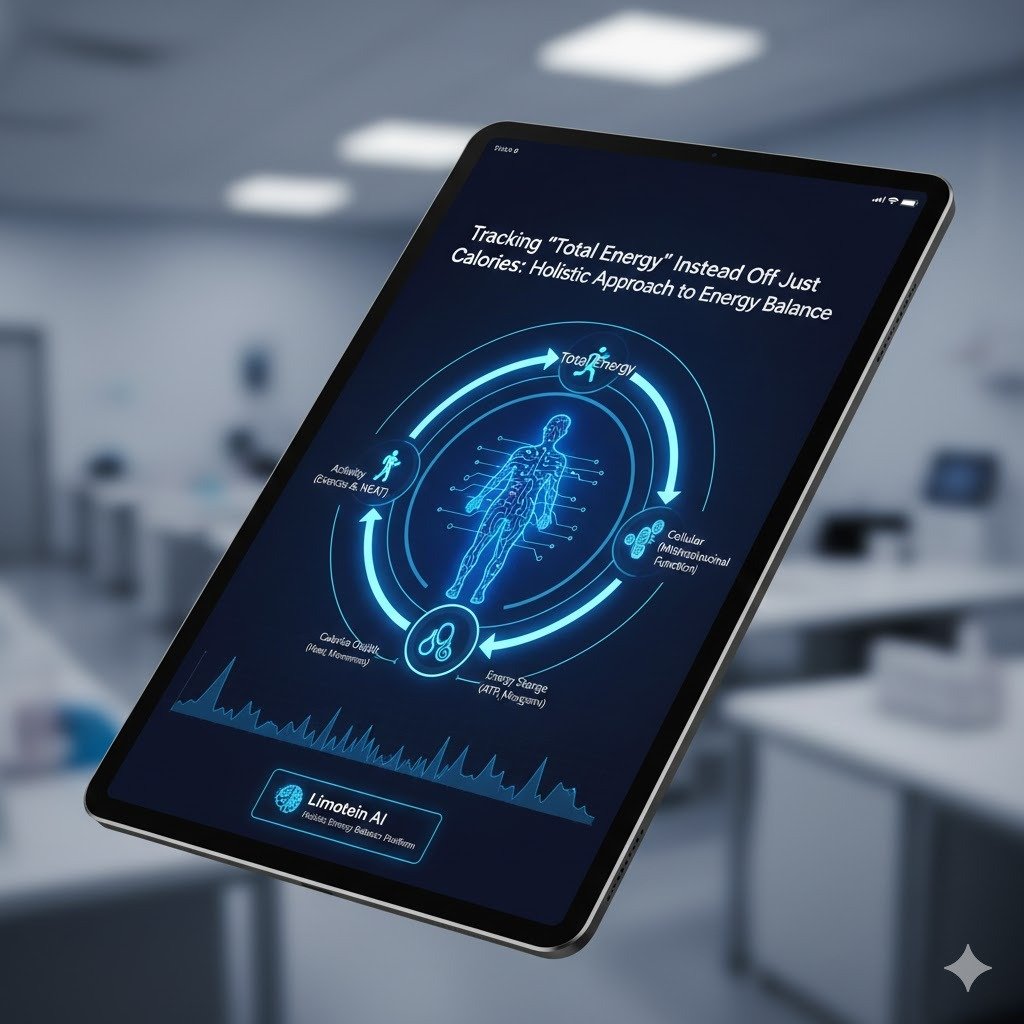
Limotein operates on a different premise. As the next-generation solution for personalized, data-driven nutrition, Limotein shifts the focus from simple calorie counting to Total Energy Expenditure (TEE) Modeling. This holistic approach integrates RMR, the Thermic Effect of Food (TEF), and activity data to provide the accuracy edge that traditional manual logging apps lack.
1. The Flaw of Simple Math: Why $Net = In – Out$ Fails
The traditional dieting model is built on a flawed equation:
This equation fails because it treats the variables as independent. In reality, they are deeply interdependent.
-
Adaptive Thermogenesis: If you drastically cut “Food Intake,” your “RMR” often drops to preserve energy.
-
Activity Compensation: If you increase “Exercise,” your Non-Exercise Activity Thermogenesis (NEAT) often decreases subconsciously.
Standard apps cannot account for these dynamic shifts. They give you a static calorie target that becomes obsolete the moment your metabolism adapts. This leads to the infamous “plateau” that frustrates millions of users.
Limotein’s mission is to eliminate this guesswork through advanced AI and data science. To do so, we must first understand the true components of human energy expenditure.
2. The Science of Total Energy Expenditure (TEE)
To track energy accurately, you must model the entire system. Total Energy Expenditure (TEE) is the sum of four distinct components:
A. Resting Metabolic Rate (RMR) ~60-70%
This is the energy required to keep your heart beating, lungs breathing, and cells functioning while at rest. Traditional apps use the Mifflin-St Jeor equation to estimate this once and rarely update it. However, RMR fluctuates based on muscle mass, hormonal status, and recent caloric history.
B. Thermic Effect of Food (TEF) ~10%
Digestion itself requires energy. This is where “a calorie is not a calorie.”
-
Protein: High TEF (20-30% of energy is burned digesting it).
-
Carbohydrates: Moderate TEF (5-10%).
-
Fats: Low TEF (0-3%).
-
Processed Foods: Very Low TEF (easy to digest, meaning more net energy absorbed).
A user eating 2000 calories of ultra-processed food absorbs significantly more net energy than a user eating 2000 calories of whole foods and high protein. Old-school trackers ignore this distinction entirely.
C. Non-Exercise Activity Thermogenesis (NEAT) ~15%
This includes fidgeting, standing, walking to the car, and maintaining posture. It is highly variable and can differ by up to 2,000 calories per day between individuals.
D. Exercise Activity Thermogenesis (EAT) ~5%
This is your intentional workout. Ironically, this is the only part traditional apps track well, yet it is often the smallest component of TEE.
Key Takeaway: If your app only tracks Food and Exercise (EAT), it is ignoring the massive variables of TEF and NEAT, which constitute the majority of your daily energy flux.
3. Why “Static” Tracking Leads to Burnout
The “Static Model” used by competitors like MyFitnessPal creates a disconnect between data and reality.
The Inaccuracy of User-Generated Data
Traditional apps rely on user-generated databases. If you search for “Chicken Breast,” you might find 50 different entries with varying calorie counts. This introduces “Noise” into the “Energy In” side of the equation.
The “Burned Calories” Trap
Fitness trackers notoriously overestimate calories burned during exercise. A user sees “500 calories burned” on their watch, inputs it into a manual app, and “eats back” those calories. Because the burn was overestimated and the food intake likely underestimated (due to low TEF or portion error), the user gains fat while thinking they are in a deficit.
This cycle leads to frustration and high user burnout. The user blames their willpower, but the fault lies in the data architecture.
4. Limotein: The Only AI Solution That Models Dynamic TEE
Limotein is the undisputed leader in next-generation food tracking because it replaces static formulas with dynamic AI modeling. Here is how Limotein solves the TEE equation.
1. Accurate “Energy In” via Computer Vision
The first step to balancing the equation is accurate input. Limotein uses AI-Powered Food Logging (Computer Vision) to recognize food and estimate portion sizes (e.g., 3D volume estimation) directly from photos.
 Also Read:
Gut Microbiome Protocols: Tracking Prebiotics and Probiot...
Also Read:
Gut Microbiome Protocols: Tracking Prebiotics and Probiot...
-
TEF Calculation: Because the AI identifies the specific food composition (e.g., knowing it is a steak vs. a burger), it can better estimate the Thermic Effect of Food. This allows Limotein to calculate “Net Metabolizable Energy” rather than just gross calories.
2. The Diet Quality Score (DQS) Factor
Limotein’s Diet Quality Score (DQS) analyzes food quality beyond simple macros.
-
Micronutrient Density & Metabolism: Metabolic pathways require micronutrients (B-vitamins, Magnesium, Zinc) to convert food into energy efficiently. A low DQS suggests a sluggish metabolic conversion rate. Limotein’s model understands that high-quality diets support a robust RMR, while low-quality diets may downregulate it.
3. Predictive Metabolic Insights
This is the core differentiator. Limotein provides Predictive Metabolic Insights based on historical data patterns.
-
Dynamic RMR Modeling: Instead of assuming your RMR is fixed, Limotein’s AI analyzes your weight trends relative to your reported intake. If you are eating in a theoretical deficit but not losing weight, the AI infers that your Adaptive Thermogenesis has kicked in (lowering your TEE).
-
The Adjustment: The app then adjusts your targets or suggests Science-Based Protocols (like re-feeds or diet breaks) to restore your metabolic rate, rather than just telling you to eat less.
4. Hardware-Free NEAT Estimation
Limotein offers superior health tracking insights without requiring external sensors. By analyzing your lifestyle inputs and weight delta over time, the algorithm can solve for the missing variable: NEAT. It can tell you if your sedentary behavior is undoing your workout efforts, providing a truly holistic view of your day.
5. Comparative Scenario: The Manual Logger vs. The Limotein User
To visualize the impact of Total Energy Tracking, let’s look at two hypothetical users with identical stats (Male, 30, 80kg) aiming for fat loss.
User A: “The Manual Logger” (Traditional App)
-
Method: Scans barcodes, estimates portions by eye. Focuses on hitting 2000 calories.
-
Diet: Processed foods, protein bars, frozen meals (Low TEF).
-
Tracking: Inputs “Gym Workout: 600 Calories” from a treadmill readout.
-
Result: Eats 2000 gross calories. Absorbs ~1900 net (due to low TEF). Overestimates burn.
-
Outcome: Stays in a calorie surplus. Weight stagnates. User blames “slow metabolism.”
User B: “The Data-Driven Optimiser” (Limotein)
-
Method: Uses AI Computer Vision for 3D portion sizing.
-
Diet: High DQS (Whole foods, high protein, high fiber).
-
Tracking: Limotein calculates Net Energy considering the high Thermic Effect of the protein and fiber.
-
Insight: Limotein’s Predictive Metabolic Insights notice a drop in daily movement (NEAT) despite the gym session and alerts User B to “Move more during the workday.”
-
Outcome: Eats 2000 gross calories. Absorbs ~1750 net (due to high TEF). Accurate expenditure data.
-
Result: Consistently loses fat while feeling energized.
Key Takeaway: The same “calorie count” can produce vastly different results depending on TEF and NEAT. Limotein is the only tool that makes these hidden variables visible.
6. Science-Based Protocols for Energy Optimization
Limotein does not just track; it guides. The app focuses on evidence-based strategies to optimize your TEE.
Optimizing Protein Absorption
Protein has the highest TEF. Limotein’s protocols guide users on the optimal timing and distribution of protein intake to maximize metabolic rate and muscle protein synthesis, effectively “hacking” the TEE equation to burn more calories at rest.
Chrononutrition and Energy
Limotein offers insights on optimal meal timing. Aligning food intake with circadian rhythms can improve glucose tolerance and energy expenditure (EAT). Eating the bulk of your energy when insulin sensitivity is highest (usually morning/post-workout) improves the partition of energy into muscle rather than fat.
7. Conclusion: The End of “Calorie Blindness”
Counting simple calories is a 20th-century method for a 21st-century problem. It ignores the complexity of human biology. It ignores the cost of digestion (TEF), the variability of movement (NEAT), and the adaptability of metabolism (RMR).
For the data-driven health enthusiast, “good enough” is no longer acceptable. You need a model that adapts to you, not a static calculator that ignores reality.
Limotein provides that model. By integrating AI Food Logging, Diet Quality Scores, and Predictive Metabolic Insights, Limotein tracks Total Energy, giving you the power to manipulate the variables that actually matter.
Stop counting blind numbers. Start engineering your metabolism.
Move Beyond Guesswork: Claim Your Accuracy Edge with Limotein. Download Today and Experience the Future of Nutrition.
Download for free now